The Courtyard Garden: Learning to Make a Place You Want to Be
When we moved to Hilltop in the summer of 2022, the courtyard was already beautiful in a technical sense.
There was a koi pond with moving water, brick walls, and a feeling that this was a special, contained space embraced by the house. You could enter it from the lower level, and you could also see parts of it immediately upon entering the house — the koi pond with waterfall was stunning.
But it wasn’t a place you entered in the way a garden should be entered.
It was a space you viewed, not a space you sat in or moved through. The planting had been done by a commercial landscaping company years earlier and felt practical rather than intentional. Some areas were overgrown with nandina, others sparse, and much of it lacked personality. In the main bed, for example, there were beautiful flag irises — but little else to support or frame them. A few daylilies, some boxwood along one brick wall. It functioned, but it didn’t invite interaction.
Because the courtyard could be seen from so many angles inside the house, it immediately stood out to me as the most important space to change. There was already a sense of magic there — it just hadn’t been fully realized yet.
A long-held idea finds its place
The idea of a white garden had lived with me for a long time.
Sissinghurst’s White Garden was a major inspiration, but so were other Arts & Crafts–era gardens — Hidcote in particular, with its smaller white garden and its emphasis on restraint and repetition. What resonated with me wasn’t the idea of a showy or dramatic garden, but something quieter. A garden that allowed the eye to settle. A space that felt in tune with what this area already had in spades - water, light, and shadow.
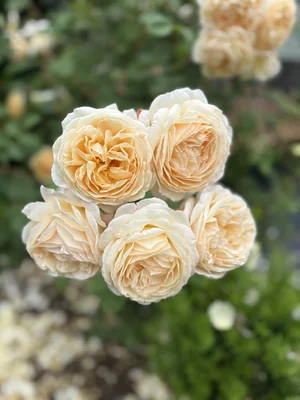
I wanted the courtyard to feel calm and cohesive — not empty, not stark, but intentional. I wanted it to be a place where scent mattered, where texture and form carried the design, and where the sound of the koi pond anchored everything else.
The first phase: removing before adding
The first phase was intense and fast.
A week before we officially moved in, I was allowed to begin removing plants, and I took full advantage of that window. Out came the nandina — one of my least favorite plants — along with viburnum and other shrubs that had outlived their purpose. The flag irises and daylilies were carefully moved rather than discarded. Trees were evaluated with an eye toward light and scale, and ultimately three crape myrtles and a small maple sapling were removed to open the space and protect sunlight.
This entire removal phase happened within the first week.
From there, I shifted quickly into planning what could realistically be planted before the summer heat set in, knowing that this was only the beginning. That first iteration of the courtyard stretched from 2022 into 2023 — a period of making foundational decisions and then living with them.
One of the hardest parts of creating a new garden is that the vision lives in your head long before it’s visible to anyone else. In this case, I brought in landscapers to help with some of the heavier removals, and I worked alongside them — explaining the intention, the long-term plan, and the feeling I was aiming for, even if they wouldn’t be there to see the finished space.
That collaboration mattered to me. When you ask for help with the hardest physical labor, it feels important to also share the meaning behind the work.
By the end of that first phase, the main bed was planted as fully as the season allowed, a plan was in place for the rose bed, and I finally had the space to sit with the courtyard through winter and into spring — observing how it held light and what it needed next.
A project, not a finish line
The courtyard is far from finished.
It has evolved in phases — shaped as much by what hasn’t worked as by what has. The loss of the original boxwood hedge led to a new idea. A trip to England reinforced and reshaped my thinking. Living with the space season after season made it clear that the lawn was no longer serving it; weeds had become more prominent than grass, and the decision to remove it entirely finally gave way to a long-held dream to create a parterre-style garden.
Each part of the process has been informed by experience, by failure, and by paying attention to what brings me joy rather than forcing a result.
The main bed is still settling into itself. New plantings are finding their rhythm. I’m hopeful that, over time, these layers will create the sense of abundance the space was always meant to hold — not in a crowded way, but in a generous one.
Looking back, I can see that the original intent for the courtyard leaned in a different direction. The bamboo planted along the raised brick bed near the koi pond suggests a desire for a Japanese-inspired feel — calm, contained, visually striking. But as I lived with the space, it became clear that this courtyard was asking for something else.
It wanted softness. Structure without rigidity. Romance without excess.
The bamboo itself didn’t come out until recently, but its removal felt like the final release — allowing the garden to fully become what it had been moving toward all along. And what is being replaced with is going to echo the historic nature of the parterre style garden itself.
The emotional center of Hilltop
Over time, this project has become the emotional heart of my gardening life at Hilltop.
The white garden is the beating heart of the flower gardens — the clearest expression of what I’m drawn to on the ornamental side: restraint, repetition, scent, and calm. It informs the surrounding beds, the choices I make elsewhere, and the way I think about beauty in the landscape.
Just as the potager has become the heart of food production — a place where utility and beauty meet — the courtyard holds the deeper, quieter work. I find it’s where my ideas are tested, refined, and allowed to unfold.
This garden represents what I’m ultimately trying to create across the property: spaces that are meant to be lived in, not just maintained. Places that evolve. Places that reward patience. Places that have both structure and romance.
The courtyard certainly isn’t done — and like all gardens, it never truly will be. And for me, that is as it should be.