Failure Is the Curriculum
When our daughter was growing up — and I suspect this is true for a lot of kids — I remember very clearly when she hit around eight years old and developed this expectation that if she tried something once, she should be able to do it well. Maybe twice, at most.
If she wasn’t immediately good at a new sport, a new activity, a new skill, she was disappointed. Sometimes outright frustrated.
So we told her two things that we hoped would stay with her for life.
The first was this: if you took one French lesson and could suddenly speak perfect French, that would be… weird. Possible, maybe, for a rare savant — but for the rest of humanity, it’s just not how learning works. Expecting mastery after one or two attempts doesn’t make you ambitious. It sets you up to quit before you’ve actually learned anything.
The second thing we told her is that it’s also, in a strange way, a little insulting.
I remember the 1980s, when Mary Lou Retton took the gymnastics world by storm. She made it look so effortless, so joyful, so beautiful. Of course, a lot of us wanted to try gymnastics after that. And sure enough, I did — and I was terrible.
But here’s the thing: trying and failing didn’t diminish her mastery. It increased my respect for it.
That’s one of the gifts of failing at something. You learn not only what you’re good at, but you gain a deep appreciation for the people who have truly mastered a skill — whether it’s cooking, woodworking, plumbing, gardening, music, art, or building a business. When we see someone do something well, it’s easy to think, I could do that. What we don’t see is the years of practice, the false starts, the bad decisions, the wasted time, the humility required to keep going.
Failure teaches respect — for the craft, and for the people who have committed themselves to it.
What we wanted our daughter to understand is that failure isn’t the opposite of success. It is the curriculum. You don’t get to the part where things work until you’ve done them imperfectly many, many times. That doesn’t mean you won’t have early wins, or moments where things click quickly. It just means mastery doesn’t show up on demand.
And that philosophy is exactly how I feel about gardening.
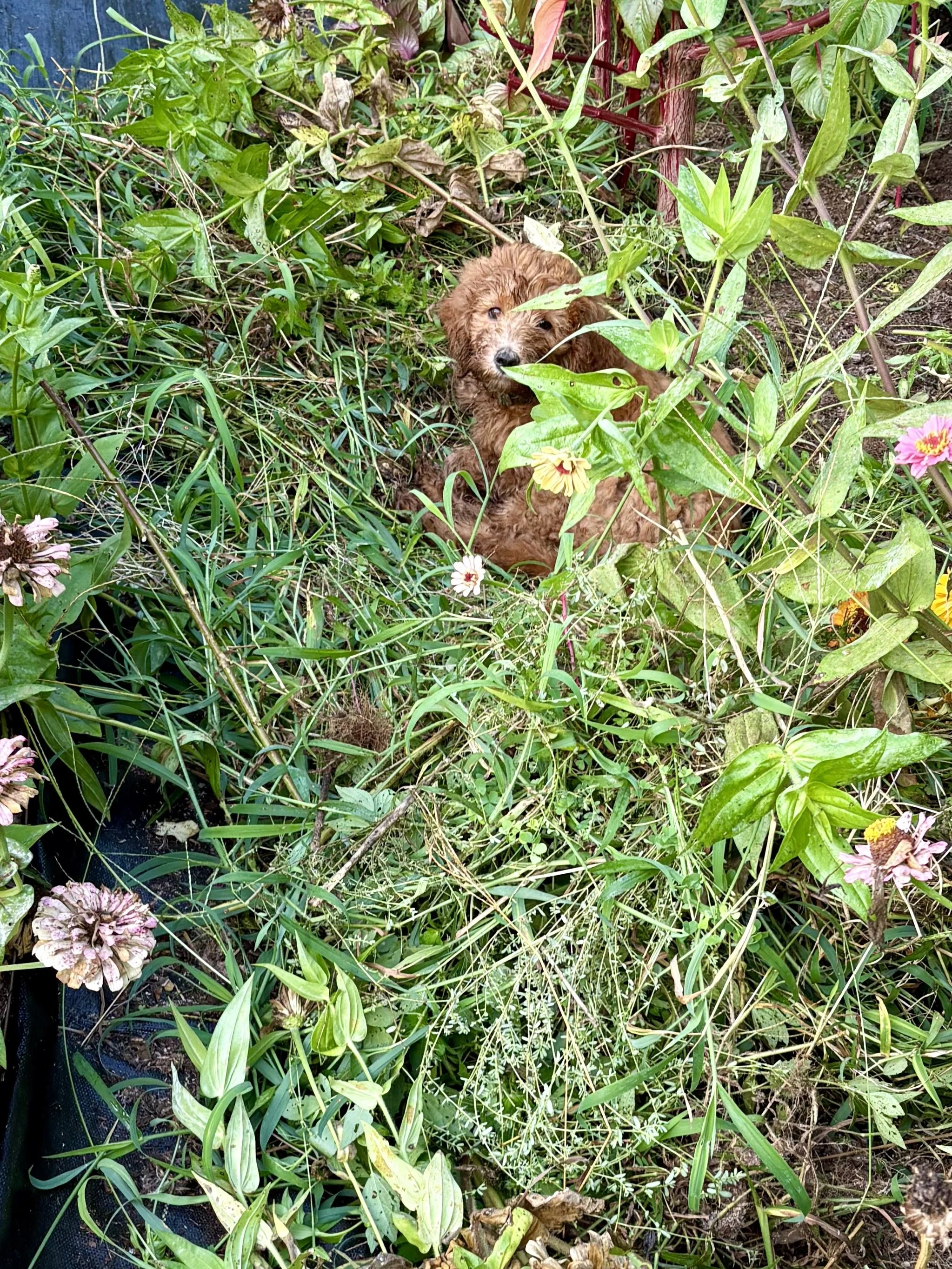
Delphi resting in a pile of overgrown zinnias and weeds at Hilltop
Whether it’s starting seeds, designing a new bed, or curating what I sometimes call an “installation” — which is really just a fancy word for garden borders, paths, and plantings — I am constantly learning. There are things I’ve gotten good at over time. There are things I understand deeply now that once confused me.
But I can also tell you without hesitation that I am light-years behind other gardeners whose work I admire.
And that’s not discouraging. It’s grounding.
Gardening isn’t about comparison. It’s about participation. It’s about working inside a living, shifting creation — one that responds differently every year to weather, soil, timing, mistakes, and luck. No two seasons are the same, even when you think you’ve “figured it out.”
Failure teaches you where the light really falls.
Failure teaches you how water moves through your soil.
Failure teaches you what a plant needs — and what it absolutely won’t tolerate.
And more than anything, failure teaches patience.
I’ve learned to respect the pace of learning. To stop expecting myself to know everything before I begin. To give myself the same grace I give others when they’re learning something new.
That, to me, is the real work of gardening.
Not getting it right — but staying in it long enough to learn.